Toronto Man Donates Original 1994 South African Multi-Racial Election Ballot

March 3rd, 2010

By Karen Bliss

A portion of the 19 political hopefuls on the 1994 South African election ballot

An original ballot from South Africa’s historic 1994 multi-racial election that voted Nelson Mandela into power and marked the end of Apartheid was donated by the Groll family last week to Nelson Mandela Park Public School in Toronto. A second ballot was given to Windfields Junior High School, also in Toronto.

“The Groll family is originally from South Africa and wanted to share this historic artifact with our school,” Windfields principal Richard Nosov wrote in an email to parents and guardians of his students.

Nosov told Samaritanmag.com that the ballot was first given to Windfields teacher Michael Clark by David Groll, whose daughter attends the school.  Clark showed it to him, and Nosov decided to contact Groll to see if he was aware of Nelson Mandela Park Public School downtown. He asked if he would consider donating the ballot there and contacted its principal, Nicole Pearson, to make the arrangements.

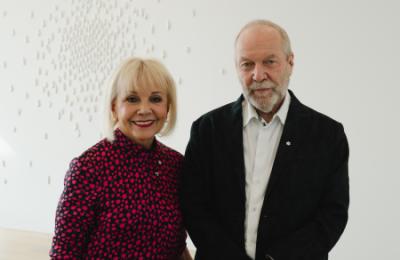
(L to R) David Groll, Nicole Pearson (principal, Nelson Mandela Park Public School), Mrs. Groll, Richard Novos (principal, Winfields Junior High School)

(L to R) David Groll, Nicole Pearson (principal, Nelson Mandela Park Public School), Aviva Groll, Richard Nosov (principal, Windfields Junior High School)

During a school assembly last week about a huge renovation Nelson Mandela Park Public School will undergo, Groll, accompanied by his wife, Aviva, presented the framed ballot and spoke “uplifting words about the power of democracy and justice,” Nosov said in the email.

“I had a chance to speak as well, and brought our two schools together by mentioning that William Harrison — who once owned the land on which Windfields Junior High School is built — lost his life in the Rebellion of 1837 fighting for democracy and responsible government in Upper Canada (now Ontario).”

Nelson Mandela, as leader of the African National Congress, was inaugurated as South Africa’s first black President on May 10, 1994. The date of that election, April 27, is now Freedom Day, a public holiday, in that country. He served until 1999. The United Nations General Assembly has also recognized Mandela’s birthday, July 18, as Mandela Day, marking his contribution to world freedom.  Mandela was imprisoned for 27 years for “crimes” committed while leading the anti-apartheid movement. He was released February 11, 1990.

  • Share/Bookmark

Two Canadians To Trek Across Siberia … Why?

February 25th, 2010
Siberia pic sized

(L to R) Kevin Vallely, Ray Zahab, Richard Weber at South Pole, January 2009

By Kevin Young

Impossible2Possible’s Siberian Express For Water will take Ray Zahab of Quebec and Kevin Vallely of British Columbia across the frozen surface of Siberia’s Lake Baikal, starting March 1. The Canadian adventurers hope to raise awareness about the worldwide scarcity of clean water, and inspire young people to push themselves beyond their perceived limitations.

The two plan to run 60 to 70 kilometers per day, without the assistance of skis or any support crew, as they attempt to make a record-setting crossing, pulling all the gear and food necessary for survival behind them on 100 pound sleds. Sponsors for the journey include Gatorade, Iridium, Apple, Nathan, Kahtoola, Canada Goose and Stratos Global.

Zahab’s mission is personal, an effort by the former pack-a-day smoker turned ultra-marathoner and adventurer, to convince young people that anything is achievable and to inspire them to act on that belief to make a positive change in their own lives and the world around them.

During the 650km run, the adventurers will use a BGAN satellite communication device provided by Stratos Global to blog, post photos and video, and videoconference live with over 10,000 participating students in North America, Germany and Russia. As the expedition progresses, students will be able to engage Zahab and Vallely directly — to see them, speak to them and hear them in real time. Others can be a part of the experience as well, by logging on to www.SiberianX.com.

On the web site, Zahab describes Lake Baikal, a designated UNESCO World Heritage Site, as “a global treasure.” The world’s largest freshwater lake by volume, it holds roughly 20 percent of the earth’s surface fresh water. It’s exactly the kind of landscape he hopes will inspire students, and others following the expedition’s progress, to seek a fuller understanding of the central role clean drinking water plays in all cultures and civilizations, as well as the issues surrounding the lack of clean water available to people around the world.

Participating schools will also have the opportunity to make a concrete contribution of their own by organizing fundraisers to aid in the completion of two African based clean drinking water projects, through Ryan’s Well Foundation and GivingWater.org.

This is hardly the first such adventure for Zahab, founder of impossible2Possible. Zahab’s 2007, 111-day, 7,500km run across the Sahara desert was the subject of Matt Damon’s documentary Running the Sahara. Following that, Zahab set his sights on conquering Antarctica in January 2009, where he, Vallely and legendary Arctic explorer Richard Weber set a record for the fastest unsupported trek across the continent to the South Pole.

But The Siberian Express For Water is only the first leg of the impossible2Possible Twenty10 H2O Initiative. To contrast the abundance of clean water found in Lake Baikal with areas where water is a scarce and desperately needed commodity, Zahab and a select group of i2p Youth Ambassadors will head back to the Sahara in April, for a 10-day, 200km run/trek across the North African country of Tunisia.

For more information, go to www.impossible2Possible.com

  • Share/Bookmark

“Hey Ayatollah, Leave Those Kids Alone” Sings Rock Band

February 24th, 2010

By Karen Bliss

Iranian Canadian rock band Blurred Vision has made a video for its poignant version of Pink Floyd’s 1979 classic “Another Brick In The Wall,” which they have subtitled “Hey Ayatollah, Leave Those Kids Alone!”  Since it was posted on YouTube February 1, it has been viewed close to 86,000 times.

With permission from Pink Floyd founder Roger Waters, they were able to change the lyrics to include, “hey Ayatollah, leave those kids alone.”

Blurred Vision — which was founded in 1998 by brothers Sepehr (singer, guitar) and Soheil (bass) and now includes Joel Lightman (keyboards) and Giampaollo Scatuzza (drums) — is donating 50 percent of the proceeds from the digital sale of the single to Amnesty International. The siblings received an honorary award back in 2005 for their work with the leading human rights organization.

Blurred Vision pic sizedSepehr and Soheil used to use their last name publicly in early press on the band, but during an introduction to an interview by CNN’s John Roberts last July about their song “Democracy” and the call by the Iranian people for change and human rights, the American Morning news anchor explained the pair was now afraid for their father, a former general in Iran’s military who still returns to their homeland, as well as for extended family members still living there.

The video was made with award-winning Iranian-born filmmaker Babak Payami (1999’s One More Day, 2001’s Secret Ballot, 2003’s Silence Between Two Thoughts), who also moved to Canada when he was a child. He intersperses real-life news footage with performance shots of the band and a storyline.

The song, produced by Canadian Terry Brown (Rush, Blue Rodeo), was released digitally all over the world on February 11 and can be purchased in all territories that have iTunes, as well as other online stores. A full-length album will soon be available via Canadian indie label C12.

  • Share/Bookmark

NYC’s Greener Gadgets Conference

February 20th, 2010

By Kevin Young

Greener Gadgets pic sized

2009 Greener Gadgets Conference panel

New York City’s third annual Greener Gadgets Conference, taking place February 25 at the McGraw-Hill Conference Centre, explores viable sustainable alternatives for the electronics we use at home, work and in between.

As a forum for discussing green technology solutions, Greener Gadgets aims to attract gadget users and electronics companies, giving them an opportunity to discuss the role gadgets play in our lives and how we might diminish their environmental impact with more sustainable designs. From eco-friendly products to energy efficient gear, the conference showcases concepts and products that both encourage and inspire us all to be greener citizens.

Register on-site with a credit card, beginning at 9 a.m. Regular attendee price is $395 and students (with proper ID) are $75. Press and bloggers (bring proper credentials) are free. For further details on the conference, including presenters/speakers,  go to www.greenergadgets.com.

The 2010 installment kicks off with a panel that starts right where we live. Entitled Green Living Begins At Home, the session will detail how a green home, whether it’s located in a rural area, a major urban center, or well off the grid, can also be a smart home. Other topics of discussion will range from the role that sustainable design can play in improving people’s lives, to personal responsibility for energy consumption, to means for companies to track their own carbon footprint.

As in the past, the grand finale of the one-day conference will be the popular Greener Gadgets Design Competition, featuring a field of cutting-edge sustainable product concepts that run the gamut from those that create their own energy to those that minimize the need for any electricity at all.

Finalists in this year’s field include: the Orange Solar Tent by Kaleidoscope (U.S.), the Go Mechanical Charger from Elephant design (India), and the Turbine light from TAK Studio (United States of America). For descriptions of these and other finalists, go to the “design competition” tab on the web site.

The final phase of the competition kick’s off after a keynote speech by Robert Fabricant, VP of creative for Frog Design Inc., which was responsible for designing the world’s first $100 “XO” laptop for One Laptop Per Child, an initiative to bring education and technology to the poorest of the world’s children.

Online voting in the Greener Gadgets Design Competition closed February 12, but will be a factor when a finalist is chosen by a panel of judges featuring Julian Lwin, owner of Lwindesign; Sarah Rich, senior editor of Dwell; and Andrew Wagner, editor-in-chief of ReadyMade.

The first place winner receives $3000; second place, $2000, and third, $1000.

  • Share/Bookmark

Pitch In So Haiti Can Pitch 1000 Tents

February 17th, 2010
Pictured: Salvation Army Coleman tent; larger ones are on the way to accommodate a small family or group of four Photo courtesy of Salvation Army

Pictured: Salvation Army Coleman tent; larger ones are on the way to accommodate a small family or group of four (photo courtesy of Salvation Army)

The Salvation Army has launched a Canadian campaign to raise money to buy 1000 tents for the survivors of last month’s earthquake in Haiti. Just drop into one of  thrift stores and make a donation or contribute online at www.tents4haiti.ca. 
All of the money collected will go directly towards purchasing tents that serve as temporary shelter.  Each participating Salvation Army Thrift Store has set a minimum of $500, enough to buy at least one tent.

“Right now, the focus of our work is shifting and the Tents for Haiti program is a unique way that Canadians can stay involved,” commissioner William Francis, territorial commander for The Salvation Army in Canada and Bermuda, said in a press statement. “We continue to serve immediate needs, but we’re also beginning to address longer-term issues, like housing, especially in the lead-up to Haiti’s rainy season this spring.”

According to figures provided by the Salvation Army, there are more than 1.2 million people homeless and more than 200,000 homes that are severely damaged or destroyed. The Salvation Army has signed an agreement with the United Nations to provide care to 20,000 Haitians and part of that agreement is to purchase tents. They will be used at relief camps in Port-au-Prince, Jacmel and surrounding areas.

There are approximately 2,900 Coleman tents on the ground right now, and The Salvation Army is in the process of sending larger, UN-approved, tents that can house a small family or group of four. The organization’s international body is also starting to provide shelter kits, which include materials such as wood, nails, and siding that can be used to erect more permanent shelters.

The United Nations designated The Salvation Army as a “lead agency” for Haiti’s disaster relief work. Since then, the organization has set-up a number of operations providing basic care, including housing, clean water, medical services and basic hygiene products.

“Our work in Haiti has never stopped,” said commissioner Francis. “On the same day that the earthquake struck, The Salvation Army began providing disaster relief services. We’ve worked in country for 60 years, and we’ll continue to serve Haiti through its rebuilding and redevelopment.”

To date, The Salvation Army has $5 million in donations from the Canadian public, and more than $200,000 in donations were raised through the Army’s Text-to-Donate program.

General donations to The Salvation Army’s Haiti Earthquake Relief Fund can be made by visiting www.tents4haiti.ca, calling 1-800-SAL-ARMY (725-2769), or by mailing your donation to The Salvation Army Territorial Headquarters, Canada and Bermuda, 2 Overlea Blvd., Toronto, ON M4H 1P4.

The Salvation Army is an international Christian organization that began its work in Canada in 1882 and has grown to become the largest non-governmental direct provider of social services in the country. The Salvation Army operates in 400 communities across Canada and 119 countries around the world.

  • Share/Bookmark